
January 7, 2026
We get it – you’re trying to close a sale in an HOA. The buyer is ready to go, and the seller wants to be done. The only thing standing between you and closing is the HOA documents. You’ve tried to get the documents with no response from the association. The community manager is charging your client a small fortune for emailed copies. It’s holding up your closing and costing your client money.
This is one of the biggest frustrations we have heard from real estate professionals, so we put together this quick guide to help break down the legal requirements and share some best practices to help you keep things moving and really look out for your clients.
Seller Disclosure Obligations
Who is responsible for HOA documents?
First and foremost, the seller is responsible for getting the HOA documents to the buyer by the disclosure deadline. Many HOA’s now use online homeowner portals that store all the documents necessary for closing. Start there and then go to the association or their manager. It sounds easy, but one of the best things you can do as a listing agent is to help your client get all the necessary documents before you even post the listing. Don’t wait!
Which documents are required to be provided?
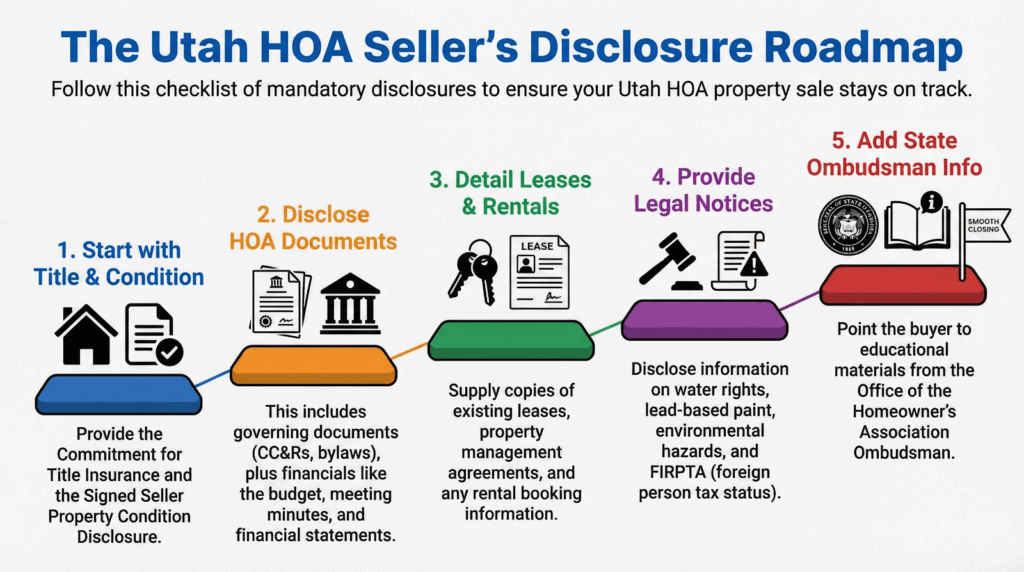
Utah law currently only requires a seller to hand over two things before closing: 1) a copy of the recorded governing documents, and 2) a link to the HOA Ombudsman’s website (hoa.utah.gov). But Section 7 of the standard REPC contract tacks on a much longer list of required documents that a seller must provide. Don’t get us wrong – when it comes to HOAs, buyers should be looking at all of this, but those extra requirements are in the REPC contract itself, not state law. If you use any other agreements or forms besides the REPC, the rules might be different, so it’s important to always double-check what the seller needs to provide.
How long does an association have to fulfill a request for documents?
In 2025, the Utah legislature changed the deadline for providing records to homeowners. It used to be 5 days, but now, an HOA (or their manager) has up to 14 days to provide the requested paperwork. That’s a long time in a real estate transaction! If the association has provided an online portal to homeowners, the documents should be available to download immediately. Sellers who have not registered for an online portal can usually find access information on their monthly assessment billing statement, so your best bet is to start there and then go to the association or manager. Whichever way you choose, start early!
How much can an association charge for document requests?
Except for payoff information (see the next section), Utah law is pretty specific on what associations or managers can charge a seller for record requests. The best option is to use an online portal where documents should be available for free. If you do have to make a request, here’s what they can charge:
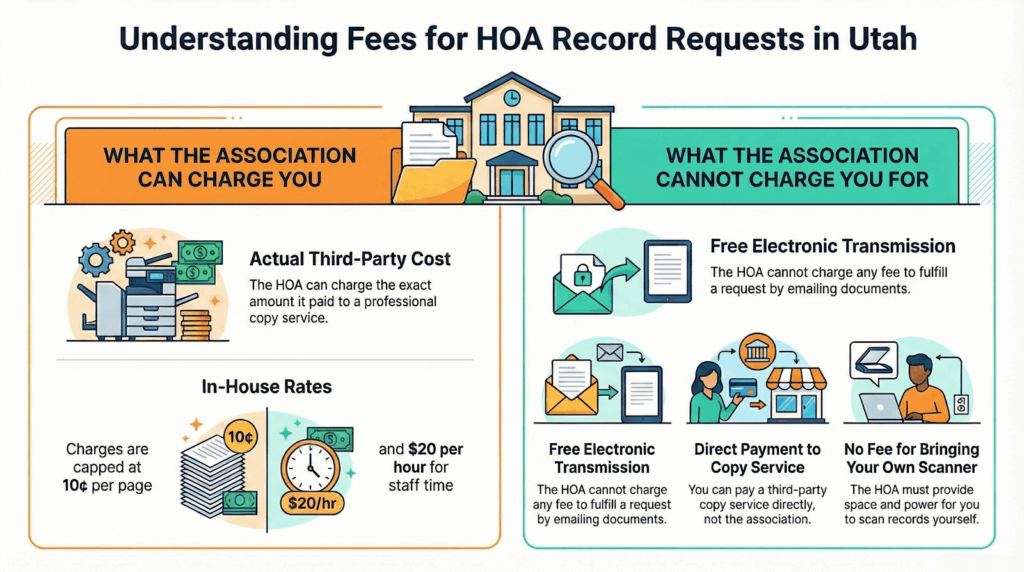
If you feel an association is unfairly charging a seller for a document request, you can always encourage the seller to submit a request for an Advisory Opinion to our office at hoa.utah.gov.
Navigating Association Payoff Demands
Association payoff information has its own set of requirements, deadlines, and costs. The info below only applies to the HOA “association payoff information” required by Utah law, not all the documents required under the REPC or other Utah laws.
What is required for a proper request for payoff information?
For a request to be legally valid, it needs to be submitted in writing to the HOA’s official contact person, which can be found on the HOA registry on our website at https://services.commerce.utah.gov/hoa/ . Make sure to include:
- The agent’s name, phone number, and address.
- A written, signed, and dated consent form from the seller that says it’s okay to release the information.
How long does an HOA have to respond, and how much can they charge?
An HOA must give you payoff info within 5 days of a valid request. Keep in mind this is a separate deadline from the 14-day rule for general records. The HOA can only charge a max of $50 for the payoff info, and they can’t ask for that fee until after the closing. The $50 cap does not apply to general records requests, which have their own rules, as stated above.
The Consequence of Non-Compliance
If an HOA does not respond to a request for payoff information within 5 business days, they usually lose the ability to enforce a lien on the property for any amount owed before the closing. If a closing is at risk because there’s no response, the closing agent needs to inform the association in writing, reminding them of the 5-day deadline and the fact that they will lose lien rights if they don’t comply.
Working with Management Companies
One of the big problems we’ve heard about from HOA management companies is that some agents don’t submit the payoff requests the right way, which causes a lot of delays. Many HOAs are now using third-party document services instead of keeping everything at their offices. Links to these sites can often be found on the association or manager’s website. Real estate professionals and title companies should make sure to reach out early to figure out the exact request process. That way, you can avoid delays from sending things the wrong way or to the wrong place.
The Agent’s Toolkit: Best Practices for a Smooth Closing
Understanding the law is important, but putting it into practice is what helps prevent closing delays. Real estate professionals can make sure everything goes smoothly for their clients by following the steps below, which are based on Utah state law and advice from HOA management companies.
Verify the Association’s Information
Before a seller makes a request, make sure they have the correct contact info! The management companies we spoke to said they often get requests that don’t include the correct name of the HOA, the complete property address of the homeowner, or the correct payoff contact, which delays their response. Don’t be that person! You can find correct contact info on the HOA Registry on our website: https://services.commerce.utah.gov/hoa/.
Help the Seller Help You!
Talk to the seller early about getting all the HOA documents. If the seller doesn’t already have them, or can’t get them through an online portal, the seller’s agent should work with the seller to send a written request to the HOA or manager ASAP. The HOA has 14 days to hand over those documents, which might be longer than the usual payoff deadline. Waiting too long to ask could delay the closing or make the seller miss the disclosure deadline. Having the documents before the listing goes live helps avoid accidental delays or slip-ups because of the HOA’s turnaround time.
Request Everything Early and All at Once
To avoid asking for things late – or twice – and possibly causing delays, make sure you know all the necessary items right from the start. This includes standard disclosures, payoff demands, lender questionnaires, and any other required paperwork. Management companies usually have their hands full managing the day-to-day tasks of their clients, and late or separate requests for the same transaction are harder for them to fulfill on time, so help them work smarter, not harder! Try to include everything in one single request to make things easier on everyone.
Distribute Documents to All Parties
Keep in mind, it’s the job of the seller and their agent to get the documents to everybody in time for all those deadlines. Be sure to include all parties who need the documents at the time of order. That way, everyone gets them fast, can review everything quickly, and you can keep things on track for a smooth closing.
Ask About Rush Options
If a closing is on a tight schedule, the seller or their agent should contact the HOA or its management company to see about any rush processing options. Although these services often involve extra fees, a 24-hour rush option can be really helpful for a time-sensitive closing.

Want to know more about these requirements or set up a training session for your group? Just reach out to us at (801) 530-6670 or visit hoa.utah.gov.


