
Frequently Asked Questions (FAQs)
General FAQs
The Office of AI Policy (OAIP) is an office within Utah’s Department of Commerce created in May 2024. We are tasked with three main objectives: Observe and Learn, Protect the Public, and Foster Innovation.
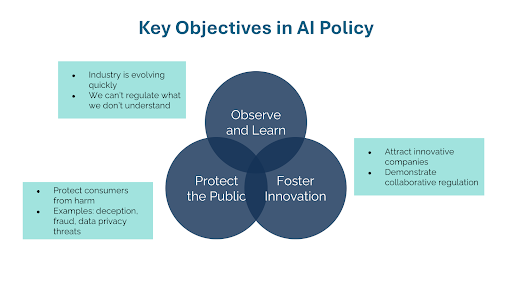
In keeping with our objectives, our Office is authorized to create regulatory mitigation Agreements to encourage beneficial and safe adoption of AI in regulated industries (See Utah Code § 13-72).
OAIP has authority to work with regulating agencies to craft regulatory mitigation agreements. (See Utah Code § 13-72.) Our office does not have unilateral authority to enforce these agreements. We obtain the approval of relevant regulating agencies (e.g., Utah Division of Professional Licensing) before any pilot may proceed.
Regulatory mitigation means giving companies and individuals flexibility on how they can be compliant with existing Utah regulations or grant exceptions to regulations when it may be in the public interest. Most regulations were written without contemplating the capacity of emerging AI technology, so we use our office’s authority to allow for temporary deployment of beneficial AI technology.
One of the main reasons for constructing these agreements is so that we can gather data to inform how to adapt existing regulations to allow for beneficial applications of AI throughout Utah.
If you want to apply for a regulatory mitigation agreement, then please email our office at [email protected].
SB 149 (2024)
Bill Sponsors: Sen Cullimore and Rep Moss
The AI Policy act created the Office of AI Policy (our office). It established liability for use of AI that violates consumer protection laws if not properly disclosed and requires disclosure when a person interacts with AI in a regulated occupation.
HB 452 (2025)
Sponsors: Rep Moss and Sen Cullimore
The Mental Health Chatbot Law established protections for users of mental health chatbots that use artificial intelligence technology. The law prohibits certain uses of personal information by a mental health chatbot and requires a mental health chatbot to make certain disclosures to users. The law enables companies to deploy mental health chatbots by providing clarity and creating clear standards for guardrails and limits.
SB 226 (2025)
Sponsors: Sen Cullimore and Rep Moss
The AI Consumer Protection law requires AI disclosures when generative artificial intelligence is used in consumer transactions (an expansion of SB 149). It also established liability for violations of consumer protection laws involving artificial intelligence.
HB 276 (2026)
Sponsors: Rep Ariel Defay and Sen Culimore
The Digital Voyeurism Prevention Act and Digital Content Provenance addresses the rising threat of deepfakes and helps the public trust what they see online. It gives people a way to take legal action if someone uses AI to create private or inappropriate images of them without their permission. The law also requires a system called "digital content provenance," which acts like a digital fingerprint for files. This system makes it easy to see if a photo or video was captured by a real person with a camera or if it was generated by a computer.
HB 408 (2026)
Sponsors: Rep FieFia and Sen McKell
The Digital Choice Act is an interoperability standard for Social Medial platforms that allows users to port their data between social media platforms more easily. This bill supports free market standards by creating a way for users to download a copy of their data off the platform and upload it to another platform.
Then please share your feedback with us. We want to hear from you.
Prescription Renewals FAQs
For the entirety of these pilots, these AI tools are only permitted to renew existing prescriptions ordered by a licensed physician. New prescriptions or changes in dose or frequency must be ordered by a licensed physician.
During the first phase, a licensed physician must review the prescription renewal recommended by the AI tool before it is sent to a pharmacist. If companies meet agreed upon benchmarks and perform well in the first phase, they will move on to the second phase.
During the second phase, the AI tool may submit the prescription renewal directly to the pharmacist. Pharmacists will retain authority to escalate any AI-generated renewals to a licensed physician within the prescribing company and pharmacists will be provided a method to directly communicate escalations with each company.
Prescription renewal pilots authorized by our office are designed to minimize impacts on pharmacist workflow.
OAIP has worked with regulators, pharmacists, clinicians, and regulatory mitigation recipients to come up with a unique formulary for each company pilot, ranging from a list of about 20 to about 200 approved medications. These formularies are designed to address common medications used for chronic conditions and mental health management, and do not include any controlled substances.
Formularies for each pilot can be found within the signed agreement.
All prescription refills are signed and approved by a licensed physician, either directly or vicariously through the AI system’s protocol. Thus, orders are still being issued by a licensed practitioner.
Our regulatory mitigation recipients are required to provide a direct line for pharmacists to communicate escalations with licensed professionals employed by the prescribing company.
During these pilots, an AI tool will never prescribe new medications. Patients must go through identity and prescription verification processes in order to qualify for AI-generated prescription renewals. Through that process, the AI-enabled prescription service will have information about the original prescribing physician and can relay necessary information to a pharmacist upon request. Additionally, there is always a physician’s name attached to a prescription authorization.
There are several relevant safeguards in place in these agreements. Controlled substances are specifically excluded from the renewal process, focusing on medications with established safety profiles for routine renewal.
Additionally, patients participating in the program will only be permitted a limited number refills per prescribed medication without a subsequent in person or telehealth visit with a clinician licensed to practice medicine in the State of Utah.
Finally, The AI system includes built-in escalation protocols that automatically refer cases to human physicians when clinical complexity exceeds predetermined safety thresholds, when conflicting information is detected, or when the patient's clinical status suggests potential medication-related complications.
OAIP receives monthly reports from regulatory mitigation recipients to monitor their work. The details of metrics to be shared in these reports are detailed in their contracts (agreements can be found on the OAIP website). OAIP carefully vets and confirms key metrics, the most important being safety.
Our office structures these pilots in a way that makes the risk of adverse events like this low, yet we recognize the possibility of such an event. Recipients of regulatory mitigation employ a licensed physician whose name appears on AI-generated prescription renewals. As a part of our agreement, we expect companies in the regulatory mitigation program to maintain medical malpractice insurance that covers AI liabilities and risk.
These pilots are a part of the Office of AI Policy’s statutory authority to authorize AI use cases requiring regulatory relief for a limited time.
For example, the Doctronic pilot will run for 1 year (Oct 2025 - Oct 2026) with the option for the office to review and renew the contract for another year.
No. Agreements are temporary and conditional on adherence to the agreement.


